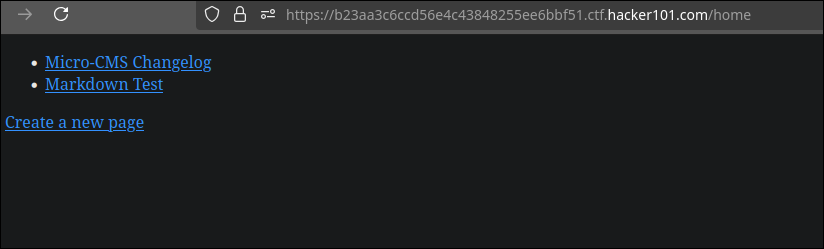
This is version 2 of the challenge Micro-CMS v1. By clicking on the Micro-CMS Changelog page, we are shown what has been changed from version 1:
Changelog Page
It seems that an authentication system has been introduced for creating and editing pages. In fact, when I try to click on Edit this page or Create a new page, I am redirected to /login:
Login
It can therefore be assumed that there is an SQL Injection vulnerability that allows us to access account notes already present in the db. In fact, when trying to submit a ' in the username field, I get an Internal Server Error:
Internal Server Error
This suggests that the query sanitization is not properly handled, and the parameters are directly passed into the query. To understand what type of SQL Injection is involved, the first thing to analyze is whether unique errors are returned for the username or just for the password. So, I submit username=admin&password=admin to see what is returned:
Unknow User
It seems that, as we can see, it returns Unknown user, which is a unique error for the username (to avoid Error Based SQL Injection, generic errors should always be used, such as username or password ... to prevent revealing useful information). This means we could try an Error Based Blind SQL Injection to enumerate the username and later the password to access the page. There will probably also be a way to perform a Time Based Blind SQL Injection. These two types of injections use linear brute force to enumerate and dump the database. An oracle query is used, which functions as a real oracle that we can ask questions. Let’s take the Error Based as an example. In this case, we ask the oracle, “Is the first letter of the username perhaps ‘a’?” The oracle responds “yes,” so we ask our next question: “Is the second letter of the username ‘a’?” and so on, until we can compose the entire username. We will use the unique error message Unknown user for this technique. For each request, we will check if the response contains that error until we successfully guess the entire username, eventually getting a different error, like wrong password. The same technique is applied for Time Based, but instead of using visible errors, it uses the response time. The query payload is built in such a way that it inserts a delay, like SLEEP(5);. This way, each time we guess a letter, SLEEP(5); will execute, and we will know it’s the correct letter by calculating the response time. If it’s approximately 5 seconds, we can move on to guessing the next letter. Let’s move on to the exploitation phase.
🔬 Vulnerability Analysis
Potential Vulnerabilities
Error Based Blind SQL Injection
IDOR
🎯 Solution Path
Exploitation Steps
Initial setup
Building an oracle for a Blind SQL Injection can be quite a hassle since you have to try and retry until you find the correct payload. Therefore, I used SqlMap since there are no rules prohibiting the use of automated tools. The first thing I did was launch SqlMap:
Specifying the username and password fields, SqlMap also identified a Time Based Injection and built the following oracle from the output:
Oracle
Once this was done, sqlmap started dumping the database. I stopped its execution with CTRL+C since sqlmap uses a session saving system, creating files so that it resumes from where it left off in the next run. Here is the resulting log:
As we can see from the log, a db called level2 and a table pages within it were found. However, I still wanted to investigate further by dumping all the db by specifying the flag --dbs:
Nothing interesting, the only database that doesn’t seem to be default is level2. From the previous output, I also found another table, admins, giving a total of two tables in level2, namely admins and pages. I assume that admins contains the users and pages contains the created pages. So, I performed the dump of the tables one by one:
As we can see, inside the admins table, there was only one user with username=donald&password=jannet. After trying to log in with this user, I obtained the first flag.
Subsequently, since we are only told that authentication has been added, I assume that the vulnerabilities from the previous challenge are still present. So, I ran the same script for enumerating the pages that I had written for the previous challenge ( enum_pages.py):
Enum Pages
It seems that there is another page which is not visible, namely page number 3. To avoid wasting time, I performed the dump of the pages table, specifying --where="id=3", so that it wouldn’t dump the first two pages:
With this, I was able to obtain the second flag, which was apparently hidden in page 3 in the database (screenshot in the Flag Capture section). Reading through the write-ups at the end of the resolution, it was also possible to access using username=' UNION SELECT '123' AS password FROM admins WHERE '1' = '1&password=123.
I caught the last flag almost by accident… always thinking about a possible IDOR, I noticed that by changing the page path from /page/1 to /page/edit/1 (just like in the previous challenge), I was redirected to /login. But then I thought, what if I accessed it using a POST instead of a GET? Since in the previous challenge, the POST method was used to modify the title and body of the page. So, I made the request with curl:
1
curl -X POST https://b23aa3c6ccd56e4c43848255ee6bbf51.ctf.hacker101.com/page/edit/1
By doing so, I obtained the third and final flag.
Flag capture
Manual Flag 1Manual Flag 2Manual Flag 3
🛠️ Exploitation Process
Approach
The automatic exploit for the second flag uses the method found in the write-up I read after solving the challenge, although I also mentioned my own method, and it seems to work. For the remaining two flags, I made a POST request to /page/edit/1 for the third flag, and accessed with the credentials extracted from the blind error-based injection for the first, extracting it from the response text using a regex.
Automated FlagScreenshot of successful exploitation
🔧 Tools Used
Tool
Purpose
Python
Exploit
SQLMap
SQL Injection Testing
💡 Key Learnings
Time Optimization
Move step by step with SQLMap, for example, first enumerate the dbs, then once you have the information, move on to dumping a specific table that you’re interested in, and so on…
Directly use a request.txt file for sqlmap, as you can copy, for example, the /login request and use it directly to set up sqlmap.